
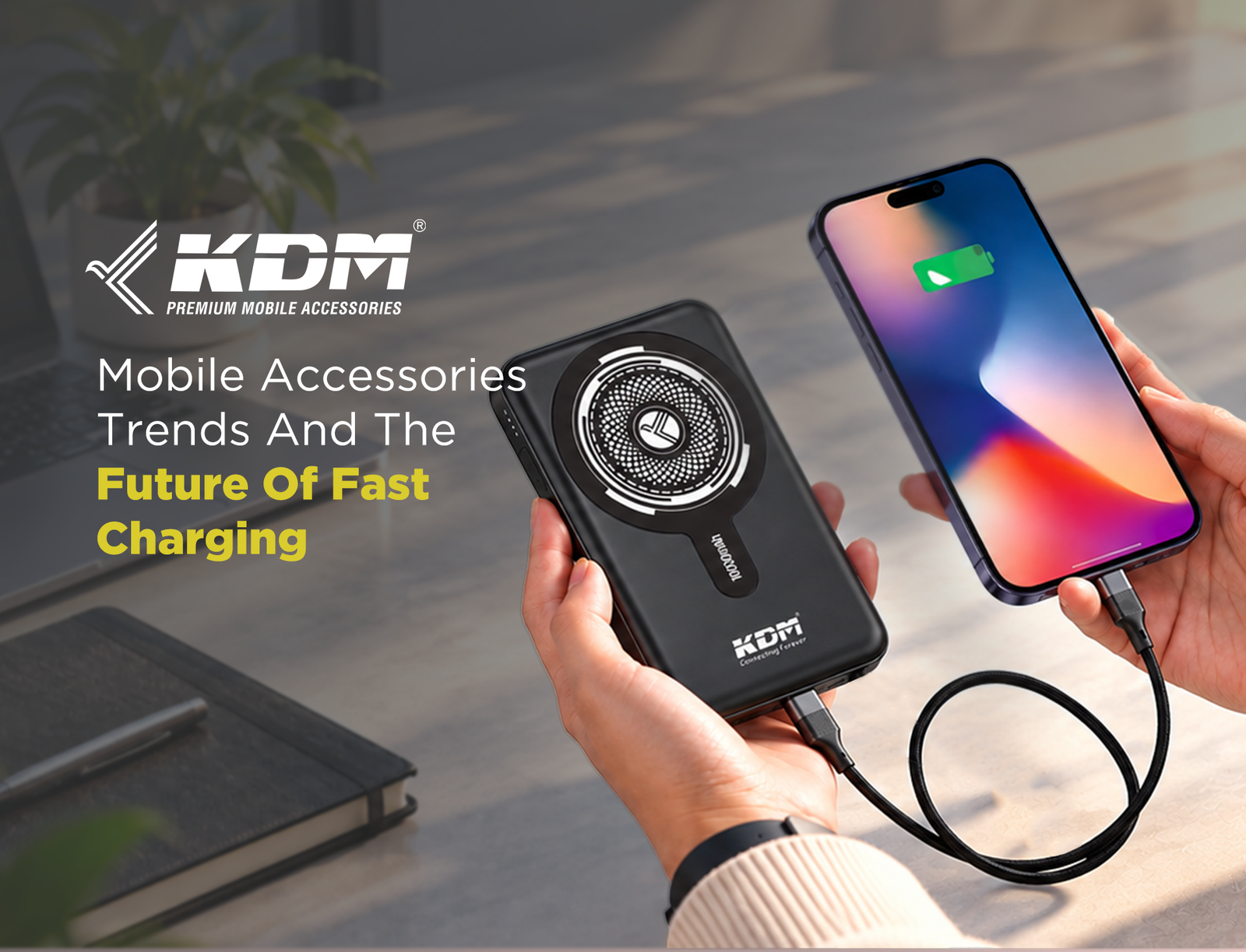
Smartphones now support communication, work, entertainment, navigation, and everyday payments. As people use them for longer hours, they expect accessories that are reliable, portable, and compatible with multiple devices. At KDM India, we recognize how these expectations are shaping demand for faster charging, compact designs, and practical connectivity.
The mobile accessories market is changing through improved power technology, cross-brand compatibility, and smarter charging controls. From compact adapters to magnetic wireless systems, new developments are changing how people power their devices. These trends help consumers choose suitable accessories and businesses plan for changing demand.
Key Mobile Accessories Trends
1. Compact GaN Chargers
Gallium Nitride (GaN) technology helps manufacturers create compact adapters that convert power efficiently. Compared with conventional silicon-based designs, GaN components can support smaller charger layouts without sacrificing output when paired with suitable thermal management and quality components.
Our modern mobile phone charger offers multiple ports for smartphones, tablets, and earbuds, reducing the number of adapters people need to carry. They suit travel, work, and homes with several devices that need a reliable mobile phone charger. Buyers should still check the rated output and safety specifications rather than choosing a mobile phone charger based on wattage or size alone.
2. USB-C And Cross-Device Compatibility
USB-C has become a common connection for smartphones, tablets, laptops, and many other electronics. Its reversible connector makes daily use easier, while USB Power Delivery (USB PD) lets compatible devices and adapters negotiate appropriate power levels.
When choosing an Android phone charger, check which charging standard the phone supports. A USB-C port does not automatically guarantee the fastest charging speed, because the device, adapter, cable, and protocol must work together. Clear specifications help users choose an Android phone chargerthat delivers the expected performance.
3. Magnetic Wireless Charging
Wireless charging is evolving through magnetic alignment, which helps compatible devices sit correctly on a charging pad. The Qi2 standard introduced magnetic alignment to a wider ecosystem, and Qi2 25W expanded supported wireless charging capability for compatible products.
This trend is encouraging demand for magnetic power banks, desk stands, car mounts, and charging docks for home, work, and travel. Performance still depends on device compatibility, certification, alignment, and temperature management, so buyers should verify support before purchasing.
4. Feature-Rich Audio And Connected Accessories
Accessories increasingly work as a connected ecosystem. True wireless stereo (TWS) earbuds offer features such as active noise cancellation, clearer call pickup, and improved battery efficiency. Smartwatches, fitness bands, speakers, and car accessories also support everyday routines.
This creates demand for reliable cables, portable power banks, and accessories that are easy to carry. Retailers can serve customers better by offering products that work together instead of treating every accessory as a separate purchase.
5. Power Banks And Sustainable Design
Many power banks now include USB-C Power Delivery, higher output, and digital displays showing battery percentage or charging information. Depending on capacity and specifications, some can charge phones, tablets, and compatible laptops.
Sustainability is another consideration. Durable braided cables, longer-lasting components, recyclable packaging, and less unnecessary plastic can help reduce waste. Durable accessories reduce the need for frequent replacements.
What Will Shape The Future Of Fast Charging?
1. Smaller, More Efficient Adapters
Further improvements in GaN components and power-management circuits could make adapters smaller while supporting higher output. Multi-port designs may allow users to charge several devices from one socket, although the total power available is shared according to the adapter’s design and connected devices.
A capable adapter will need to balance size, output, and thermal performance, while a well-designed mobile phone chargermust remain reliable. Compact construction should never come at the expense of electrical safety or reliable operation.
2. Smarter Power Delivery
USB PD allows compatible devices to negotiate voltage and current within supported limits. Future multi-port adapters may adjust power distribution as devices connect or reach different charging stages.
For anyone selecting an Android phone charger, compatibility remains more important than headline wattage. A high-output adapter cannot make a phone accept more power than its charging system supports.
3. Faster Wireless Charging With Better Heat Control
Magnetic alignment can improve the positioning of compatible devices, while evolving standards continue to develop wireless charging performance. Future charging stations may offer more convenient setups for desks, bedside tables, and vehicles.
Heat control remains essential because wireless power transfer generates heat. Buyers should choose reputable, compatible products and remember that advertised maximum output is not guaranteed for every phone.
4. Battery Health And Adaptive Charging
Charging speed is only one part of the experience. Temperature, battery chemistry, charging habits, and device design all affect long-term battery health. Smartphones use battery-management systems to regulate power, while features such as adaptive charging can adjust charging schedules on supported devices.
Our suitable mobile phone charger and compatible cable help provide dependable power. Avoid damaged cables, poorly made adapters, and equipment that becomes unusually hot during normal use. Follow the phone manufacturer’s instructions for charging and battery care.
Comparing Charging Trends
| Trend | Main benefit | What to check |
|---|---|---|
| GaN adapters | Compact and efficient design | Output and thermal protection |
| USB-C Power Delivery | Charging across compatible devices | Protocol and cable rating |
| Qi2 wireless charging | Magnetic alignment | Certification and phone support |
| Multi-port adapters | Charge several devices together | Shared output across ports |
| Adaptive charging | Helps manage charging routines | Phone features and settings |
These changes also affect the supply chain. Mobile phone accessories manufacturers must respond to evolving device requirements, product quality expectations, and demand for compatible charging solutions. Retailers and distributors should review specifications, quality assurance, and reliable supply before expanding their ranges.
A mobile phone accessories wholesaler can also consider demand for USB-C cables, fast-charging adapters, power banks, and wireless charging products when planning inventory. Offering options for different budgets and device needs helps customers make informed choices.
How To Choose The Right Mobile Phone Charger
- Check compatibility: Confirm the phone’s charging protocol, connector, and maximum input power.
- Choose suitable wattage: Higher output helps only when the connected device supports it.
- Prioritise safety: Look for reputable products with appropriate protection against overheating, overcurrent, and overvoltage.
- Use a suitable cable: The cable must support the required power level.
- Match the product to your routine: Travellers may prefer compact adapters, while households may benefit from multi-port options.
These checks keep attention on safety, performance, and long-term usefulness.
Summary:
Mobile accessories are moving towards better compatibility, compact construction, intelligent power management, and more convenient charging. GaN adapters, USB-C Power Delivery, magnetic wireless charging, and battery-management features are likely to remain important as devices and consumer expectations evolve.
At KDM India, we believe that understanding these developments helps consumers and businesses make better-informed decisions. Prioritizing compatibility, reliable construction, and useful features helps buyers choose well, as do fast-charging advances.
FAQs
1. What are the latest mobile accessories trends?
Key trends include compact GaN adapters, USB-C charging, magnetic wireless charging, higher-output power banks, feature-rich wireless earbuds, and more sustainable designs.
2. How do I choose a mobile phone charger for my smartphone?
Check your phone’s supported charging protocol, maximum input power, connector type, and recommended cable. Choose a reputable adapter with suitable electrical protections.
3. Is a higher-wattage mobile phone charger always faster?
No. Speed depends on the phone’s supported power, charging protocol, cable, battery temperature, and current charge level. A higher-rated adapter cannot override the phone’s limits.
4. Is wireless charging better than wired charging?
Wireless charging is convenient and reduces cable handling. Wired charging is often more energy-efficient and may be faster on compatible devices. The best option depends on your needs and device support.
5. Can fast charging damage a smartphone battery?
Fast charging is generally safe when supported by the phone and used with suitable equipment. Excessive heat can accelerate battery aging, so use compatible accessories and follow the manufacturer’s guidance.